
Clarity in Chaos: A Simple Map to Stop Overthinking and Start Moving Forward
Updated: May 1
Use this 4-step Clarity Map to sort your thoughts, focus your energy, and take one clear action when life feels uncertain.
When your mind feels loud, start here
Some days, the problem is not that you don’t care.
It’s that you care about too many things at once.
Your future. Your career. Your family’s expectations. Money. The market. The news. The decision you keep delaying.
And suddenly, your mind starts looping.
You think. Then rethink. Then research. Then ask someone. Then doubt yourself again.
It feels like progress. But often, it is just overthinking wearing a productivity costume. Very convincing. Very annoying.
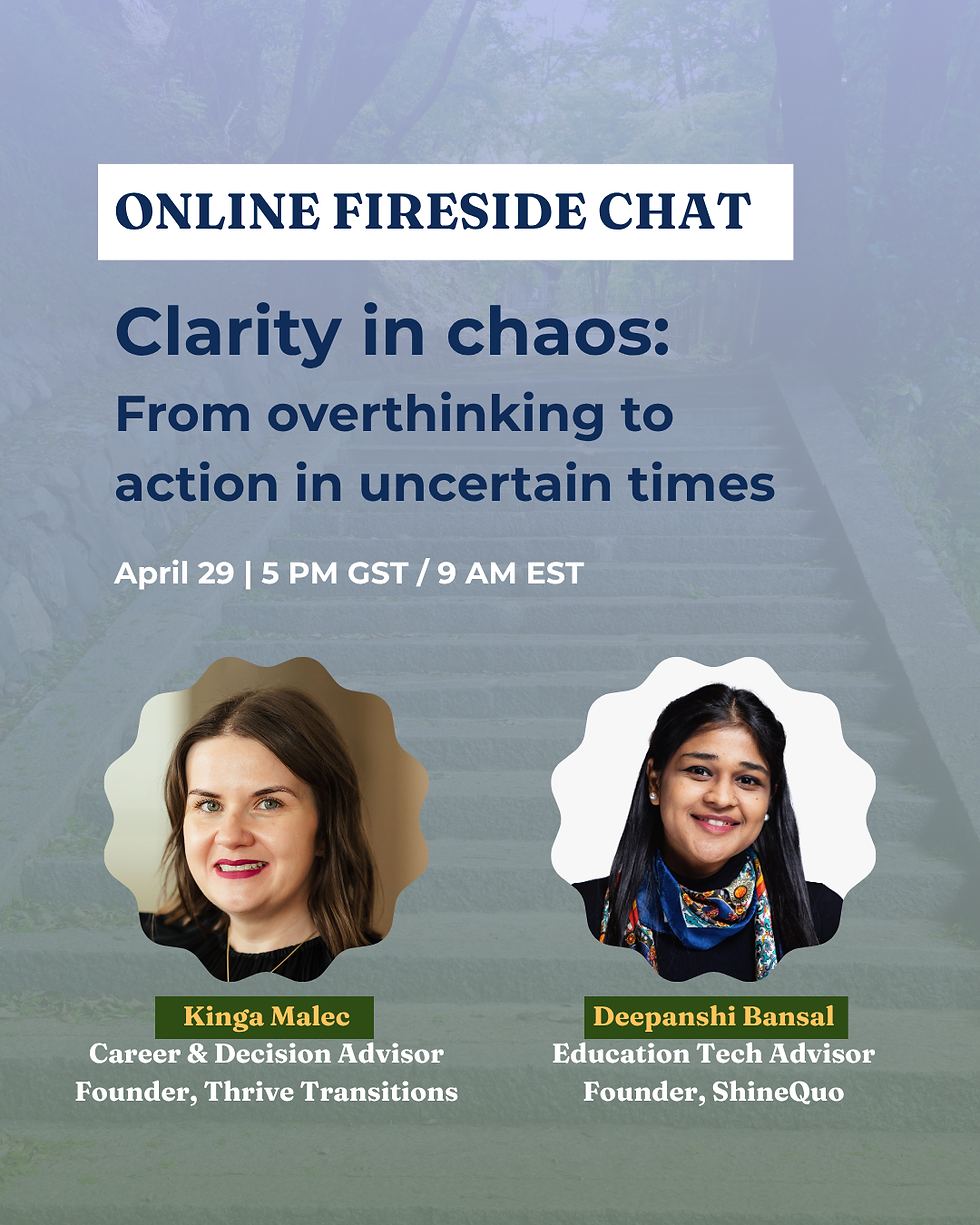
At ShineQuo’s session on April 29th, “Clarity in Chaos: From Overthinking to Action in Uncertain Times,” Kinga Malec, ICF-certified coach and Career & Decision Advisor, shared a simple truth:
“You don’t need certainty to move forward. You need to know what is yours to act on.”
That is where the Clarity Map comes in.
Why uncertainty makes us overthink
Our brains like prediction.
When life feels uncertain, the brain tries to scan for what might happen next. That is useful when we need to prepare. But when there are too many unknowns, the mind can get stuck in loops.
Research on uncertainty and decision-making shows that uncertainty increases cognitive control demands, meaning the brain works harder to monitor, predict, and choose under unclear conditions. In simple English: uncertainty makes your brain do extra mental labor. Cute little biological overachiever.
Research also connects intolerance of uncertainty with indecisiveness and safety behaviors, meaning when people struggle with uncertainty, they may delay decisions or keep seeking reassurance instead of acting.
That is why overthinking can feel useful.
It gives a temporary sense of control.
But as procrastination research explains, people often delay action not because they are lazy, but because the task or decision feels emotionally uncomfortable. Procrastination can become short-term mood repair: we avoid the discomfort now, even if it costs us momentum later.
So the goal is not to “stop thinking.” The goal is to think better.
The Clarity Map: 4 steps from overwhelm to action
The Clarity Map helps you sort your thoughts into four buckets:
Out of Control
Influence
In Control
Action
This is not about pretending everything is fine. Please, we are not doing toxic positivity in this economy.
It is about asking: Where should my energy actually go?

Step 1: Out of Control
Let it go, or at least stop feeding it all your attention.
Start by writing down what is out of your control.
Examples:
The job market
Global events
Other people’s decisions
Whether someone replies
The exact outcome of an interview
What your family thinks immediately
This step matters because many people spend most of their mental energy here.
But if you cannot directly change it, it should not be the place where your brain lives full-time.
Kinga framed this beautifully in the session:
“Clarity begins when we stop trying to control what was never fully ours to control.”
Step 2: Influence
What outcome matters to you?
Next, write down what you want to influence.
This is different from control.
You may not control getting the job. But you can influence your chances.
You may not control how someone responds. But you can influence how clearly you communicate.
You may not control the future of the market. But you can influence your readiness.Examples:
Building confidence in interviews
Strengthening your network
Improving your visibility
Creating better options
Making a decision with more confidence
This step helps you move from vague worry to a specific focus.
Instead of “Everything is uncertain,” you start asking: What outcome do I care about most right now?
That question alone can reduce mental clutter.
Step 3: In Control
What can you actually do?
Now ask:
What is in my control that could influence that outcome?
This is where your power comes back.
Examples:
Updating your resume
Practicing your interview story
Messaging one person
Applying to three roles
Booking a coaching session
Learning one skill
Asking for feedback
Sleeping properly before an important decision
Preparing instead of spiraling
This is the part most people skip. You jump from worry straight into panic. Lovely human tradition. But the brain needs a bridge.
The bridge is this question:
What can I do that makes the outcome more likely, even if I cannot guarantee it?
That is practical clarity.
Step 4: Action
Choose one next step.
Finally, write down one action you will take.
Not ten. Not a full life transformation plan. Not “become a new person by Monday.”
One action.
Examples:
Send one message
Apply to one opportunity
Write down the decision I am avoiding
Ask one mentor for advice
Spend 20 minutes preparing
Book one support conversation
Make the first draft
Take the next step I already know I need to take
Research on implementation intentions shows that people are more likely to follow through when they turn goals into specific action plans. In other words, “I should network” is weak. “Tomorrow at 10 AM, I will message one alum on LinkedIn” is stronger.
Action creates clarity because it gives your brain feedback.
You learn by moving.
Not by thinking yourself into a mental pretzel.
Try it now: 5-minute Clarity Map exercise
Pick one situation that has been taking up space in your mind.
Now fill this out:
1. Out of Control
What can I not control here?
2. Influence
What outcome do I care about?
3. In Control
What can I do that may influence that outcome?
4. Action
What is one step I can take in the next 24 hours?
That is it. Just one clear next step.
Download the Clarity Map template as Google Sheets, make a copy, fill it out, and choose one action you can take today.
Why this works
The Clarity Map works because it helps your brain separate:
Noise from signal
Fear from fact
Outcomes from actions
Thinking from movement
It gives structure to uncertainty.
And structure matters.
As Kinga shared during the session:
“Insight is powerful, but without structure, it fades quickly.”
That is the whole point. You do not need to wait until everything feels certain. You need a way to move while things are still uncertain.
🌱 Want help beyond this one exercise?
The Clarity Map is a great start.But clarity isn’t a one-time activity. It’s something you build over time.
If you’re still feeling stuck, unsure, or going in circles…
You don’t have to figure it out alone.
At ShineQuo, we help students, early professionals, and higher education communities move from confusion → clarity → action through structured coaching and support.
What that looks like:
1:1 coaching conversations (real, practical, not fluffy)
Clear action plans after every session
Ongoing support so you don’t fall back into overthinking
A space where you can think out loud and move forward
👉 Create your account and connect with a coach to work through your areas of chaos - one step at a time. |
Frequently Asked Questions (FAQs)
How is ShineQuo different from therapy?
ShineQuo is focused on action and forward movement.
If therapy helps you process the past, ShineQuo helps you:
make decisions
build clarity
take structured next steps
It’s about moving forward in real-time, especially in areas like career, life decisions, and personal growth.
What happens in a ShineQuo coaching session?
You don’t just “talk.”
You:
explore what’s actually going on
break down your situation
identify what’s in your control
leave with clear, actionable steps
Every session ends with something you can do, not just something you understood.
I’m not sure what I need help with. Can I still join?
Yes. Most people start there.
You don’t need a perfectly defined problem.If you’re feeling:
stuck
overwhelmed
unsure about decisions
That’s enough.
Clarity is built during the process, not before it.
Is this only for students?
No. While students and recent graduates can create their account here , ShineQuo also works with professionals and higher education staff. You can join the professional platform using this link
Anyone navigating transitions, decisions, or uncertainty can benefit.
How quickly will I see results?
You’ll likely feel more clarity after your first session.
But real progress comes from:
consistent reflection
structured action
accountability
That’s why ShineQuo's platform is built considering all this in mind. We recommend ongoing support for atleast 2 months, not one-time advice for better results.
What if I’ve already tried figuring things out on my own?
Most people have. The difference is:
👉 thinking alone often leads to loops
👉 structured guidance leads to movement
ShineQuo helps you break that loop.
Do I need to be “ready” to start?
No. You don’t need:
perfect clarity
confidence
a full plan
You just need:
👉 willingness to take one step
That’s enough to begin.
👉 “You don’t need to have everything figured out. You just need a better way to move forward.”


Comments